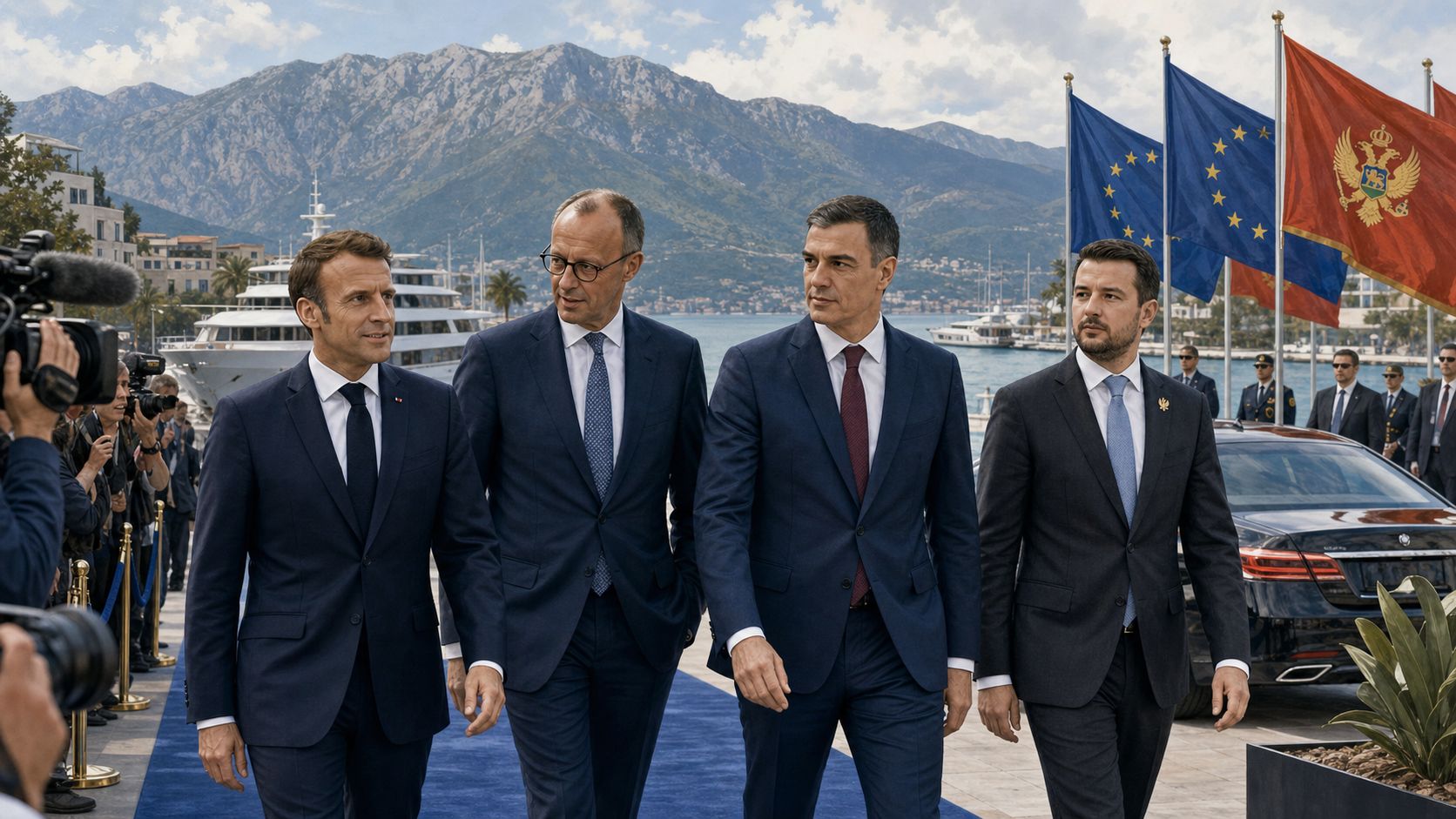
Montenegro will host the European Union–Western Balkans Summit in Tivat on 5 June. On paper, this is a regional summit. In political terms, it is far more than that.
The expected arrival of leaders such as Emmanuel Macron, Friedrich Merz and Pedro Sánchez, with confirmation still awaited from Giorgia Meloni and others, gives the event a level of visibility rarely seen in Montenegro’s modern diplomatic history. Since the restoration of independence in 2006, Montenegro has not hosted a French president or a German chancellor. That alone makes the summit symbolically important.
But symbolism is only the beginning.
The real question is whether Montenegro can use this moment to strengthen its position as the most advanced EU candidate country — not only through protocol and hospitality, but through political seriousness, institutional discipline and reform delivery.
A Small State Hosting a Large Political Moment
For a country of Montenegro’s size, hosting around 40 delegations, hundreds of journalists and up to 1,000 participants is a major logistical and security operation. The choice of Tivat and Porto Montenegro gives the summit a strong visual identity: a small Adriatic country presenting itself as stable, open, European and capable.
That image matters.
International politics is not shaped only by formal declarations. It is also shaped by impressions of capacity, confidence and reliability. A successfully organised summit would send a message that Montenegro can manage high-level international events with seriousness and precision.
This is not a minor point. EU membership is not only a legal and technical process. It is also a political judgement about whether a state is ready to function inside the Union. In that sense, Tivat becomes a stage on which Montenegro must demonstrate institutional maturity.
Why This Summit Matters for Montenegro
The summit comes at a sensitive and potentially favourable moment. EU enlargement has returned to the centre of Europe’s strategic agenda, partly because of the war in Ukraine, partly because of renewed concern over instability and external influence in the Western Balkans.
For years, enlargement was treated as a slow, technical and often abstract process. Today it is again a geopolitical question.
That creates an opening for Montenegro. Unlike some countries in the region, Montenegro has no unresolved bilateral dispute of comparable weight blocking its European path. It is a NATO member, it has long aligned itself with EU foreign policy, and it remains the candidate country most often described as closest to membership.
But this advantage is not permanent. It can be lost.
The summit therefore offers Montenegro a rare opportunity to reinforce the message that it is not merely part of the Western Balkans package, but the candidate most capable of moving first.
The Risk of Mistaking Visibility for Progress
There is, however, a danger. Montenegro’s political class has often treated international praise as a substitute for domestic reform. A summit, no matter how important, does not close negotiating chapters. It does not reform the judiciary. It does not strengthen public administration. It does not resolve political polarisation.
European leaders may come to Tivat. But they will also look beyond the scenery.
They will look at whether Montenegro can maintain institutional stability, deliver rule-of-law reforms, reduce political obstruction, strengthen administrative capacity and avoid turning EU integration into another field of party competition.
The summit can improve Montenegro’s diplomatic standing. It cannot compensate for weak implementation.
That distinction is essential.
The Message to Brussels
For Brussels, Tivat provides an opportunity to show that enlargement is still alive and that the Western Balkans remain part of Europe’s strategic horizon. The EU’s Growth Plan for the Western Balkans is designed to offer earlier access to some benefits of integration, provided that candidate countries deliver reforms and strengthen regional economic cooperation.
This is important, but it also carries a clear message: early integration is not a political gift. It is conditional.
Montenegro must therefore use the summit to position itself as a country capable of absorbing the benefits of early integration, implementing reforms and demonstrating that enlargement can produce a credible success story.
That is the argument Montenegro should make.
Not that it deserves membership because it has waited long enough, but that it is institutionally and politically ready to move faster than the rest of the region.
The Message to Montenegro
The summit also sends a message inward.
If Montenegro can organise a high-level international event involving the EU’s most powerful leaders, then it should also be able to organise a more disciplined national approach to EU accession. The same coordination required for protocol, security, transport, communications and diplomacy is needed in the reform process.
EU accession is not only the responsibility of one ministry or one government. It requires the judiciary, parliament, public administration, municipalities, civil society, media and political parties to act within a shared national framework.
That is where Montenegro has often failed.
The country knows how to declare European commitment. It has been less consistent in building the institutional habits needed to sustain it.
Tivat should therefore be read not only as a diplomatic achievement, but as a reminder of what disciplined state coordination can look like when there is political will.
A Test for President Milatović and the Government
The summit also has domestic political implications.
As host, President Jakov Milatović gains an important diplomatic platform. The Government, ministries, police, local authorities and state institutions will also be judged by how effectively they manage the event. Success will require coordination across institutions that are often divided by political rivalry and administrative weakness.
This makes the summit a test of state functionality.
If Montenegro manages the event professionally, it will strengthen the argument that the country can act responsibly when the stakes are high. If the event is marked by confusion, rivalry or poor coordination, it will reinforce doubts about institutional capacity.
The political benefit of the summit will therefore depend less on photo opportunities and more on execution.
Montenegro Must Use the Moment
The core strategic point is simple: Montenegro should not treat the Tivat summit as an end in itself.
It should use the event to launch a more focused political push towards EU membership. That means setting a credible reform calendar, communicating clearly with EU capitals, strengthening implementation capacity and showing that Montenegro can move from diplomatic visibility to measurable progress.
The country should also use the presence of European leaders to make one argument consistently: Montenegro can become the EU’s next enlargement success story, but only if the EU rewards credible progress and Montenegro delivers reforms without delay.
Both sides have responsibilities.
The EU must show that the accession process is real and that results are recognised. Montenegro must show that it is not relying on favourable geopolitics alone.
Conclusion: Europe Comes to Tivat, but Montenegro Must Move
The EU–Western Balkans Summit in Tivat may become one of the most significant diplomatic events in Montenegro’s recent history. It will place the country before a European audience and offer a powerful image: Montenegro as a small state capable of bringing Europe together on the Adriatic.
But the image will matter only if it is followed by action.
Tivat can strengthen Montenegro’s European profile. It can demonstrate organisational capacity. It can remind Brussels that Montenegro is the most realistic candidate for the next stage of enlargement.
Yet the summit will not, by itself, bring Montenegro into the EU.
That task remains where it has always been: in institutions, reforms, political responsibility and the ability of the state to act with seriousness after the cameras leave.
The opportunity is real. The test begins after the summit ends.
Comments
There are no published comments yet.