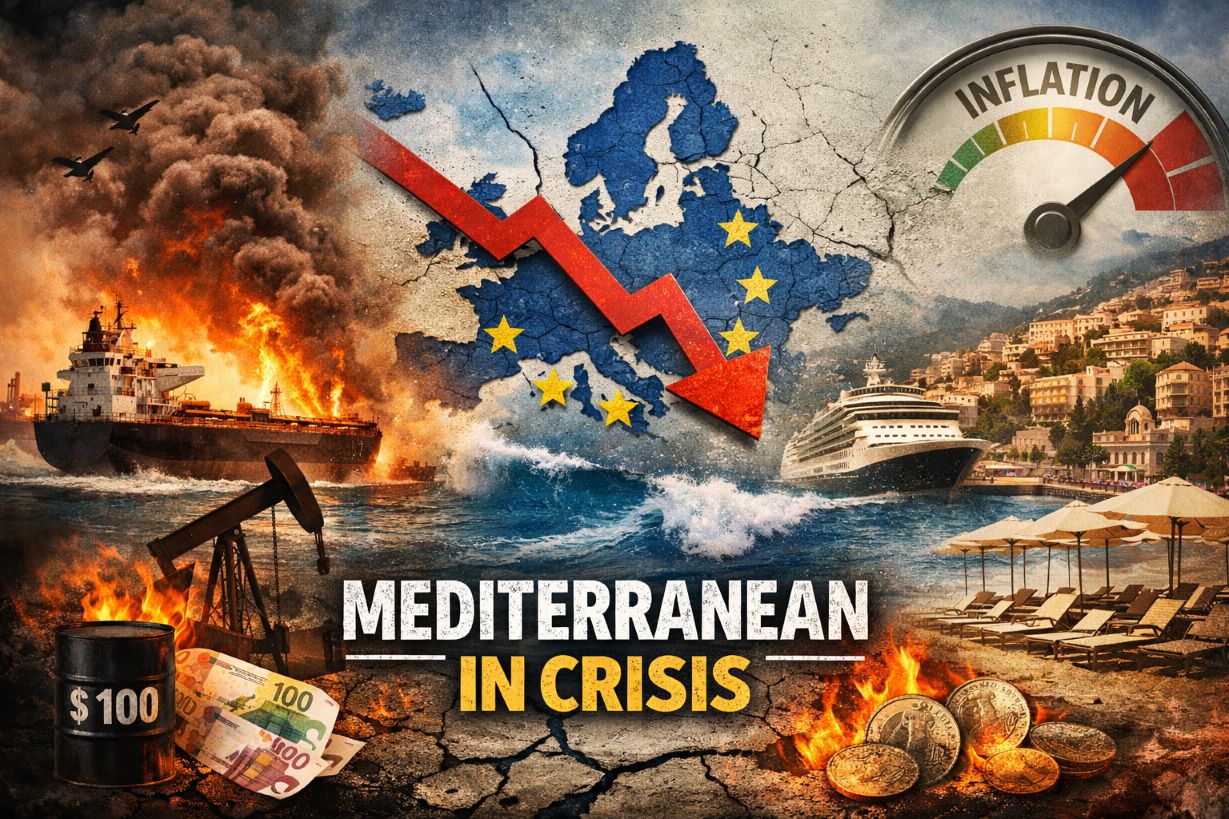
Wars in the Middle East do not stay in the Middle East. They arrive in Europe through oil prices, shipping routes, insurance costs, inflation and public anxiety — and they arrive in the Mediterranean first.
That is the uncomfortable reality now confronting the European Union as the conflict involving Iran sends fresh shockwaves across energy markets and maritime corridors. For Brussels, this is not some distant geopolitical drama to be monitored from conference rooms and summit statements. It is the return of a familiar European problem: imported instability with a direct cost for households, businesses and governments.
And once again, the Mediterranean sits on the front line.
Too much of the public debate is still framed in shallow, almost comforting terms. Will some tourists avoid riskier destinations and choose southern Europe instead? Could Mediterranean countries benefit from diverted travel? Possibly. But that is the wrong question, or at least a secondary one. The Mediterranean is not simply a holiday basin. It is one of Europe’s main economic corridors — a space of ports, shipping, aviation, energy imports, logistics and services. When the Gulf catches fire, the consequences do not stay there for long.
The first shock is energy. Europe may have reduced some of its previous vulnerabilities, but it remains exposed to turbulence in global hydrocarbon markets. When war pushes up oil and gas prices, the effect does not stop at household utility bills. It runs through transport, food, freight, manufacturing and tourism. Airlines pay more for fuel. Hotels pay more for electricity and deliveries. Hauliers pay more to move goods. Consumers absorb the pressure and then cut spending elsewhere.
For Mediterranean economies, that matters more than many in Brussels like to admit. Southern Europe is heavily exposed to transport-intensive sectors and to the political consequences of inflation. Higher fuel costs do not merely squeeze business margins. They revive social pressures, fiscal tensions and political discontent in countries that have only recently emerged from one inflationary shock. Governments that were just beginning to stabilise now face the prospect of another imported crisis.
The second shock is maritime insecurity. The Mediterranean is tied to wider trade systems that depend on stable and predictable transit routes. Once strategic waterways come under pressure, energy facilities are threatened and insurance costs rise, the impact is no longer theoretical. Freight becomes more expensive. Delivery times become less reliable. Importers become more cautious. Ports, shipping firms and supply-dependent industries all start pricing risk differently.
This matters because Europe’s economic model depends on predictable movement. The EU likes to speak the language of resilience, strategic autonomy and preparedness. But those ideas mean little if the Union still reacts to each external shock as though it were an unexpected interruption rather than a recurring structural problem. The Mediterranean is precisely where those structural weaknesses are exposed first.
The third shock is confidence. Households respond to uncertainty long before economists finish their forecasts. Businesses delay investment. Investors become cautious. Travellers postpone bookings, shorten stays or reduce spending. Even where tourism numbers remain broadly stable, revenues can weaken because visitors become more price-sensitive. For Mediterranean economies already struggling with high costs, seasonal dependence and weak productivity growth, that is not a minor adjustment. It is another stress test.
This is why the comforting theory that southern Europe could somehow gain from instability elsewhere is dangerously simplistic. Yes, some travellers may redirect their plans. Yes, some destinations may capture bookings lost by riskier markets. But a region does not become more prosperous simply because it is marginally safer than a war zone. If the broader European consumer is squeezed by energy-led inflation, any tourism benefit will be limited, uneven and temporary.
Brussels should therefore resist the temptation to see this crisis through a narrow tourism lens. The more serious frame is infrastructure, energy and economic security.
First, the EU needs to treat the Mediterranean as critical economic infrastructure, not merely as a geographic space between crises. That means stronger contingency planning for ports, shipping flows and freight disruption. It means recognising that the region is central to Europe’s functioning, not peripheral to it.
Second, Europe needs a more serious approach to energy resilience. Diversification, storage coordination, demand management and faster deployment of renewable energy are not only climate goals. They are instruments of strategic protection. Every new conflict that sends oil and gas prices upwards is another reminder that dependency carries a cost.
Third, governments in southern Europe should avoid blunt and expensive political gestures. Broad fuel subsidies may look decisive, but they are usually fiscally wasteful and poorly targeted. Support should go to vulnerable households and the most exposed sectors, not to everyone equally. The Mediterranean does not need theatrical politics. It needs competent cushioning.
Fourth, tourism policy needs realism. Mediterranean governments should prepare for volatility rather than fantasise about windfalls. That means better transport planning, greater energy efficiency across the hospitality sector, smarter destination management and a stronger focus on value rather than volume. In a more unstable geopolitical environment, resilience matters more than record visitor numbers.
The deeper problem is that Europe remains structurally exposed. Each new external crisis reopens the same weakness: the EU is economically large, but still too vulnerable to imported shocks in energy and trade. The Mediterranean reveals that weakness early because it concentrates so many of the Union’s pressure points — ports, shipping, tourism, energy transit, migration politics and supply chains — in one region.
That is the real lesson of the war involving Iran. It is not simply another conflict on Europe’s periphery. It is a reminder that the Mediterranean is where geopolitical instability becomes economic reality for the European Union.
If Brussels has learned anything from the shocks of recent years, it should stop treating resilience as a slogan and start treating the Mediterranean as Europe’s next economic frontline.
Comments
There are no published comments yet.