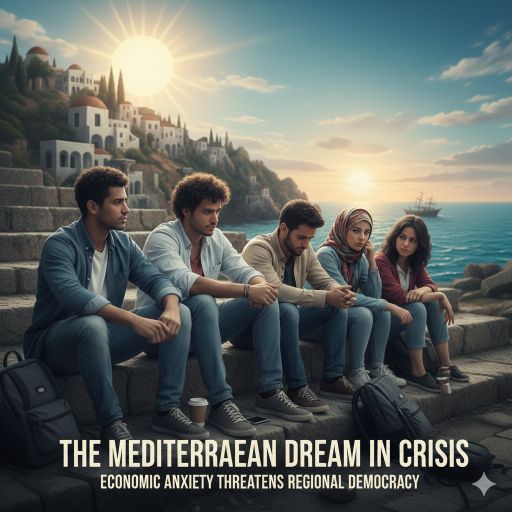
The Mediterranean has always lived with crisis. Empires rose and fell here, wars crossed its waters, and political orders were repeatedly tested along its shores. Yet the danger now confronting the region is quieter and, in some ways, more corrosive: a prolonged erosion of economic hope.
When ordinary people conclude that hard work no longer leads to security, democracy becomes more fragile. That is not a theoretical concern. It is one of the central political lessons of modern history. Persistent inflation, stagnant productivity, unaffordable housing and blocked social mobility do not simply weaken household finances; they weaken trust in institutions, mainstream parties and democratic compromise.
Across the Mediterranean basin, that erosion is now visible.
What is under strain is more than growth. It is the old social bargain that shaped much of the post-war Mediterranean imagination: the belief that each generation could realistically expect greater stability than the one before it. For millions of younger people, that promise is fading into something more modest and more anxious — delayed adulthood, insecure work, unaffordable cities and an increasing sense that opportunity belongs to investors, insiders or emigrants rather than to citizens who stay.
The warning signs are now too widespread to dismiss as national exceptions.
In southern Europe, the housing crisis has become one of the clearest symbols of generational blockage. Eurostat reports that in 2024 young people in the EU left the parental home at an average age of 26.2, but the figure was far higher in parts of the Mediterranean: 30.0 in Spain, 30.1 in Italy, 30.7 in Greece, 31.3 in Croatia and 28.9 in Portugal. Eurostat also reports that housing-cost pressure remains acute, with Greece recording by far the highest housing cost overburden rate in the EU in 2024, at 28.9%.
This is not merely a lifestyle shift. It is an economic signal. It reflects a region in which wages, rents, access to credit and patterns of investment are increasingly misaligned. The European Commission’s housing work in late 2025 concluded that affordability has worsened across the EU, especially in urban areas, with serious social and economic consequences. The OECD’s 2026 survey of Portugal makes the same point directly: young people are disproportionately affected by the housing squeeze.
Italy illustrates a related pressure: the loss of talent. The European Commission’s 2025 Education and Training Monitor notes that employment outcomes for recent tertiary graduates remain among the weakest in the EU and that poor prospects are pushing growing numbers of graduates abroad. National data cited by the Commission show that more than one million Italians moved abroad between 2014 and 2023, including 367,000 people aged 25 to 34, of whom nearly 146,000 held tertiary degrees. OECD data also show that emigration of Italian citizens to OECD countries remained high, at 152,000 in 2023.
In the Western Balkans, the problem looks slightly different but leads to a similar conclusion. The World Bank’s latest Regular Economic Report describes a labour-market paradox: labour shortages coexist with unemployment above 10%, labour-force participation below 55%, and especially weak outcomes for women, youth and older workers. It also warns that the working-age population is projected to shrink sharply by 2050. That is not merely a labour-market issue; it is a long-term democratic risk for already fragile states.
Across North Africa and the wider MENA region, the picture is equally troubling. World Bank data continue to show very high youth unemployment in the region, while the Bank’s latest regional analysis notes that growth remains too weak to address the employment needs of large youth populations. This helps explain why migration remains, for many educated young people, not a personal aspiration but an economic necessity.
Türkiye offers the most extreme inflationary version of the same story. While price growth has slowed from its earlier peaks, both the IMF and the European Commission expect inflation to remain high in 2026, with services and rents still exerting strong pressure on household budgets. When citizens experience prolonged inflation, the effect is not only material. It is psychological. People stop trusting the future.
The common Mediterranean problem, then, is not just poverty. It is blocked advancement. Too many citizens are educated enough to know what a decent life should look like, but increasingly unable to reach it through normal economic channels.
That is where the democratic risk emerges.
Economic frustration does not automatically produce authoritarian politics, but it creates fertile ground for populists, demagogues and patronage networks. When people cease to believe that institutions can deliver fairness, they become more open to leaders who promise disruption instead of reform. That dynamic has already reshaped politics across parts of southern Europe and the Balkans. The Economist Intelligence Unit’s latest Democracy Index and the European Commission’s 2025 rule-of-law reporting both point to continued governance and democratic vulnerabilities across parts of the region, including the Western Balkans.
The Mediterranean still has immense strengths: geography, human capital, ports, tourism, agriculture, maritime industries and cultural reach. But these assets are being undermined by policy failures that are now regional in character.
Education systems remain too disconnected from labour-market realities. Housing policy is too often shaped around investors rather than residents. Labour markets reward incumbency and connections more than productivity and skills. Economic models built around tourism, construction and consumption have not generated enough resilient, high-value opportunities for younger generations. Climate stress, energy shocks and geopolitical instability are making the problem worse, not better. Recent EU and ECB assessments already warn that the war involving Iran could raise inflation, weaken growth and intensify stagflation risks across Europe — pressures the Mediterranean will feel early and sharply.
What is needed is not nostalgia for a vanished Mediterranean dream, but a new democratic bargain built on realism.
First, governments need to reconnect education and training with actual opportunity, including technical skills, logistics, blue economy sectors, digital trades and modern hospitality management. Second, housing policy must prioritise affordability for residents, particularly younger households, rather than treating real estate primarily as an asset class. Third, regional governments should stop competing destructively for low-value seasonal gains and instead build common strategies around energy resilience, transport, skills and innovation. Fourth, democratic reform must be treated as inseparable from economic reform. Citizens are more likely to defend institutions they believe can still improve their lives.
The Mediterranean crisis is therefore not simply economic, and not yet fully political. It sits dangerously between the two.
If this region continues to produce educated but insecure citizens, rising prices without rising prospects, and property wealth without social mobility, then democratic erosion will not come as a surprise. It will come as the logical outcome of a promise withdrawn.
The Mediterranean has survived war, empire and upheaval. But the test now is whether it can still offer its own people a believable future.
Comments (moderated)