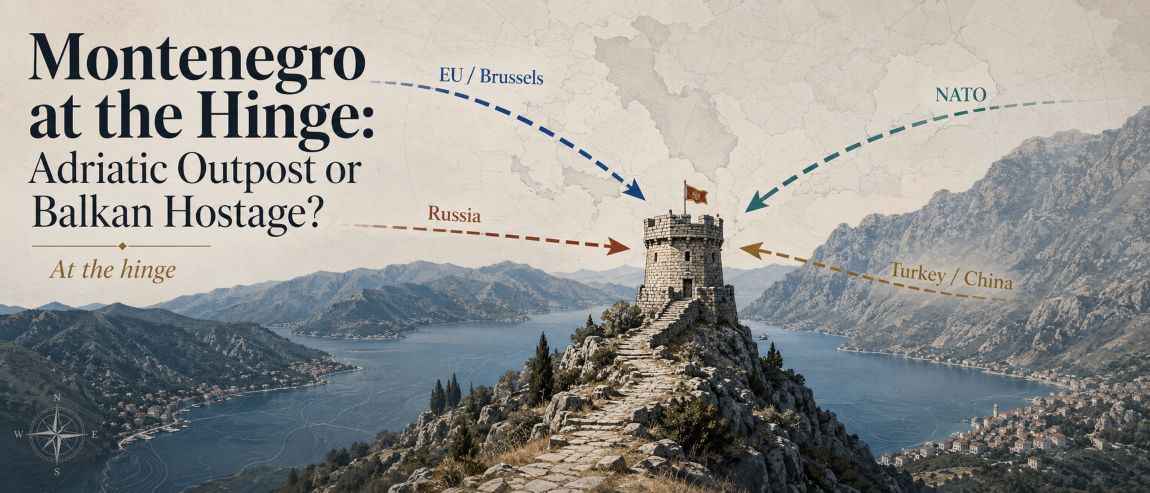
To understand Montenegro's strategic position, one must resist the temptation of viewing the Balkans as a unified space awaiting consolidation. The region, like the broader Mediterranean of which the Adriatic is a northern extension, is not an arena that will eventually produce coherent order. It is, structurally, a zone of overlapping influence — and Montenegro has survived precisely by mastering that condition.
The Adriatic's confined geography has always imposed constraints that the wider Mediterranean could not. Where the Eastern Mediterranean dissolves into competing sub-regions with overlapping EEZ disputes and great-power energy rivalries, the Adriatic compresses its rivalries into more legible forms. Fragmentation exists here, but it is bounded.
Montenegro occupies a peculiar position within this bounded space. With 295 km of coastline — including the Bay of Kotor, one of the finest natural harbors in southern Europe — it commands maritime access that far exceeds what its 620,000 inhabitants might suggest. This disproportionality between territorial weight and strategic geography is the defining feature of Montenegrin statecraft across centuries.
Montenegro joined NATO in 2017, a decision that crystallized the country's western orientation and provoked a sharp reaction from Moscow. Since then, the country has pursued EU membership as its primary strategic objective — currently the most advanced candidate in the Western Balkans accession process in terms of chapters opened, though still constrained by unresolved rule-of-law benchmarks.
Yet formal alignment does not resolve structural ambivalence. Serbia, with which Montenegro shares deep cultural and historical ties, remains outside NATO and maintains a delicate balance between Brussels and Moscow. The Serbian Orthodox Church retains significant influence within Montenegro itself, as the contentious 2019–2021 religious property dispute demonstrated. These internal vectors complicate any clean reading of Montenegrin strategic identity.
The country's political class has oscillated between pro-European reformers and nationalist coalitions with closer ties to Belgrade and, indirectly, to Russian interests. The 2020 parliamentary shift that ended three decades of Democratic Party of Socialists dominance introduced governing uncertainty that Brussels has watched with concern. Governance fragility is not merely a domestic matter — it conditions the pace and credibility of EU accession.
The Balkans function, in Saul Cohen's terminology, as a shatterbelt — a zone of internal fragmentation reinforced by constant external pressure. The actors applying that pressure have multiplied since the Cold War's clean bipolarity dissolved. The EU, the United States, Russia, Turkey, China, and Gulf states all project influence into the region, each through different instruments: enlargement conditionality, energy infrastructure, religious networks, port investments, road corridors.
Montenegro's Bar port, long eyed by Chinese investors through the Belt and Road framework, exemplifies how infrastructure competition shapes the sub-regional landscape. The highway connecting Bar to Boljare — partially financed by Chinese loans — produced a debt controversy that tested Podgorica's room for maneuver and revealed the limits of small-state agency when great-power financing is involved.
Turkey's quiet re-engagement with the Western Balkans, conducted through cultural diplomacy, religious networks, and bilateral trade, adds another layer. For Ankara, the Balkans represent a zone of Ottoman historical memory and present strategic interest — a space where Turkey can project soft power without direct confrontation with NATO allies, given that most Balkan states are now members or partners of the alliance.
The Republic of Ragusa — Dubrovnik — spent centuries surviving in an Adriatic space compressed between Venice, the Ottomans, and the Habsburgs. It did so not through strength, but through diplomatic intelligence, studied neutrality, and the careful management of its navigational and commercial position. Its survival was a function of institutional sophistication and strategic patience, not power projection.
Montenegro's longue durée offers a parallel. The Montenegrin tribes held out against Ottoman absorption not through grand alliance but through terrain, resilience, and the symbolic weight of a small principality that refused reduction. The modern state carries this memory — sometimes productively, as diplomatic self-confidence; sometimes as an obstacle to the institutional compromises that European integration demands.
The lesson for Podgorica is structural: in a fragmented region that resists unified order, smaller states survive by being indispensable to multiple actors simultaneously — while never becoming captured by any one of them. This requires exactly the flexibility, precision, and patience that the Ragusan tradition exemplified.
The EU enlargement process, long stalled, has acquired new urgency since 2022. Russia's war in Ukraine reframed the Western Balkans as a strategic vulnerability — a space where European inaction could produce instability far closer to the continent's core than previously imagined. Montenegro, as the most formally integrated of the candidates, stands to benefit from this recalibration — if it can deliver the domestic reforms that Brussels requires.
Whether it will depends less on geopolitics than on internal political coherence. A Montenegro capable of sustained institutional reform can leverage its NATO membership, its coastline, its tourism economy, and its strategic position between the Adriatic and the Balkan interior into a durable place in a polycentric Europe. A Montenegro mired in governance crisis risks becoming an instrument of others' agendas rather than an author of its own.
The Adriatic is bounded but not resolved. Montenegro sits precisely at that boundary — connected to Europe by aspiration and alliance, connected to the Balkan interior by geography and kinship. The geopolitical future of the region will not produce a unified strategic order. It will produce overlapping influence zones, external interventions, and sub-regional competitions. Within that structure, small states with clear strategic identities and flexible diplomacy can do more than survive. They can, in the Ragusan tradition, endure.
Comments
There are no published comments yet.