Land governance remains one of the most politically sensitive and administratively complex areas of reform across the Middle East and North Africa. Reliance on outdated paper records, overlapping claims, and opaque registration systems continues to fuel disputes, weaken institutions, and deter investment.
Yet today, digital governance and AI applications are offering governments practical tools to address these long-standing challenges—making land registries more secure, transparent, and citizen-centered.
From Paper to Smart Cadastres
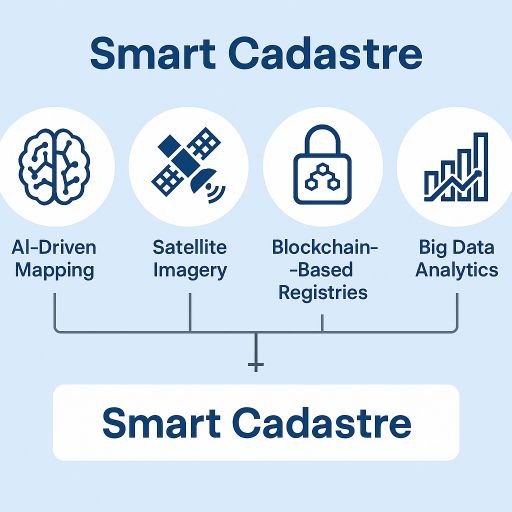
The concept of “smart cadastres” goes beyond digitization. It combines artificial intelligence, satellite imagery, blockchain, and big data analytics to modernize property management systems, reduce corruption, and build citizen trust.
The Technologies Driving Change
-
AI-driven and satellite mapping
High-resolution imagery and AI algorithms can identify informal settlements and unregistered parcels. This helps governments create more inclusive registries while accelerating land administration. -
Satellite imagery and drones
Real-time monitoring enables detection of encroachments, verification of agricultural claims, and tracking of urban growth—strengthening institutional oversight and transparency. -
Blockchain potential
While still at pilot stage globally, blockchain can provide tamper-resistant ownership records, ensuring data integrity and reinforcing trust in public institutions. -
Big data analytics
Integrating land registries with data from courts, utilities, and finance systems allows detection of fraud patterns, prevention of overlapping claims, and evidence-based urban planning.
Why This Matters for the Middle East and North Africa
The region faces urgent governance challenges: rapid urbanization, displacement linked to conflict and climate change, contested inheritance rights, and tribal or communal disputes. Smart cadastres can:
-
Reduce disputes by providing transparent and verifiable records.
-
Unlock credit markets by enabling households and SMEs to leverage land assets.
-
Support climate resilience and reconstruction, particularly in fragile contexts like Iraq.
-
Curb corruption by replacing opaque paper trails with digital accountability.
UN-Habitat’s Social Tenure Domain Model (STDM) and Land Administration Domain Model (LADM) provide a phased pathway—balancing inclusivity with interoperability and international standards.
The Political Economy Challenge
Digital transformation of land governance is never just technical. It requires:
-
Legal reforms to ensure digital records carry legal weight.
-
Institutional coordination among ministries of justice, finance, planning, and interior.
-
Capacity building so civil servants can operate and maintain new systems.
-
Public trust, built through inclusive processes that protect women, youth, and displaced persons.
Looking Ahead
The Middle East and North Africa are at a pivotal moment. Governments that embrace digital governance and AI-powered land administration can lay foundations for economic diversification, social inclusion, and climate adaptation. Those that delay risk deepening inequalities and prolonging instability.
Smart cadastres are not about technology for its own sake—they are about governance innovation: building transparent, secure, and citizen-focused systems that bridge the gap between people and their land.
Comments (moderated)